

The Triumph of the King
From the Fragrance of Bethany to the Coronation

Most of us have heard the story of Palm Sunday, but have we missed the coronation? In this study, we peel back the layers of traditional teaching to reveal the “visible keys” by which the early church used to understand the true nature of Christ’s victory. Was the Triumphal Entry a humble arrival, or was it a high-definition claim to Deity and a declaration of war against the powers of darkness? Join us as we explore how a Roman military tradition and an ancient Greek word reveal the staggering truth of the King’s return to a renewed Earth.
The Triumphal Entry
John 12:12–19 (LSB)
12 On the next day the large crowd who had come to the feast, when they heard that Jesus was coming to Jerusalem, 13 took the branches of the palm trees and went out to meet Him, and began to shout, “Hosanna! BLESSED IS HE WHO COMES IN THE NAME OF THE LORD, even the King of Israel.” 14 And Jesus, finding a young donkey, sat on it; as it is written, 15 “FEAR NOT, DAUGHTER OF ZION; BEHOLD, YOUR KING IS COMING, SEATED ON A DONKEY’S COLT.” 16 These things His disciples did not understand at the first; but when Jesus was glorified, then they remembered that these things were written about Him, and that they had done these things to Him. 17 So the crowd, who was with Him when He called Lazarus out of the tomb and raised him from the dead, continued to bear witness about Him. 18 For this reason also the crowd went and met Him, because they heard that He had done this sign. 19 So the Pharisees said to one another, “You see that you are gaining nothing; look, the world has gone after Him.”
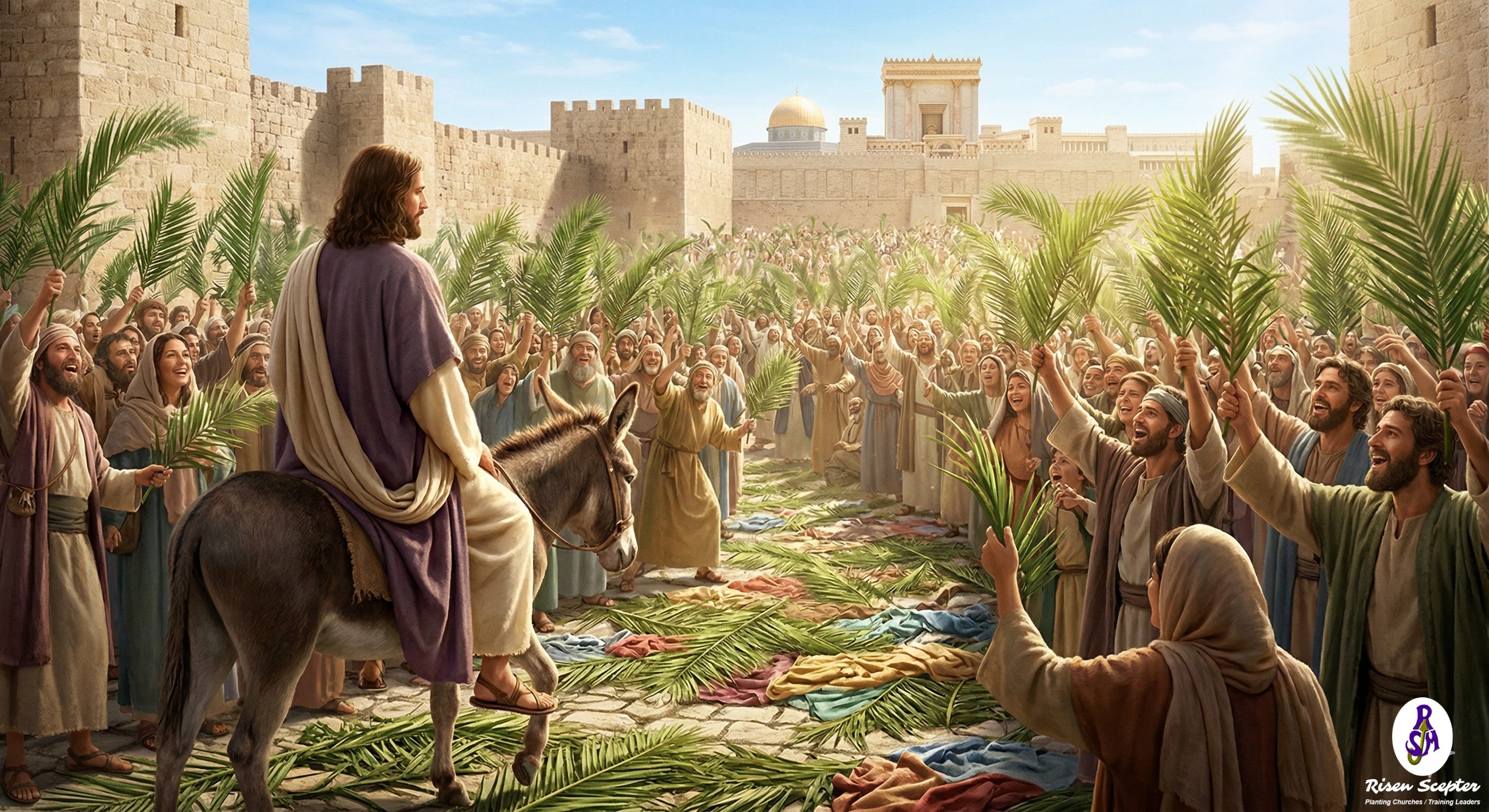
While this entrance into Jerusalem is known as the Triumphal Entry, it was the culmination of a series of events that began just days prior. To grasp the deep theological weight of this moment, we must look at what transpired “behind the scenes” in Bethany—starting with a miracle that forced a confrontation with eternity.
Setting the Scene: Revealing of Identity
Chapters 11 and 12 of John’s Gospel mark a critical pivot in the narrative of Christ. In chapters 1-12 was the public ministry of Jesus. He had revealed who He was through a progressive unfolding of His ministry and character through chapter 10. However, in Chapter 11, the raising of Lazarus acts as a final “seal” on His public claims.
Because Bethany was only about two miles from Jerusalem (15 stadia), a massive crowd had gathered to console Martha and Mary. When Jesus arrived, He offered a definitive claim to deity. He told a grieving Martha: “I AM the resurrection and the life” (Jn 11:25).
There are 7 “I AM” statements in John’s gospel (Jn 6:35; Jn 8:12; Jn 10:7; Jn 11:25; Jn 10:11; Jn 14:6; Jn 15:1) Yet, what is striking about this phrase is: In Greek, this is Ego Eimi—the absolute, non-predicate form of the verb “to be.” It is the identical phrase used in the Septuagint when God spoke to Moses at the burning bush: “I AM who I AM” (Ex 3:14). Jesus was not merely claiming to have the power to raise the dead; He was identifying Himself as the Self-existent – Self-contained – Self-complete – Tri-unity.
The Jews who had come to console Lazarus’ sisters witnessed their brother being raised from the dead, and the report of the miracle spread like wildfire. Therefore, many of the Jews who had come believed in the Lord (11.45)
Yet, some of the other Jews reported the event to the Pharisees, which convened a meeting concerned that it would draw the attention of their Roman oppressors (11:48).
This brought about a plot to kill Jesus (11:57)
John tells us that after the reaction of the Jewish leaders, “Jesus therefore no longer walked openly among the Jews” (11:54).
A turning point had come
A House Filled with Fragrance
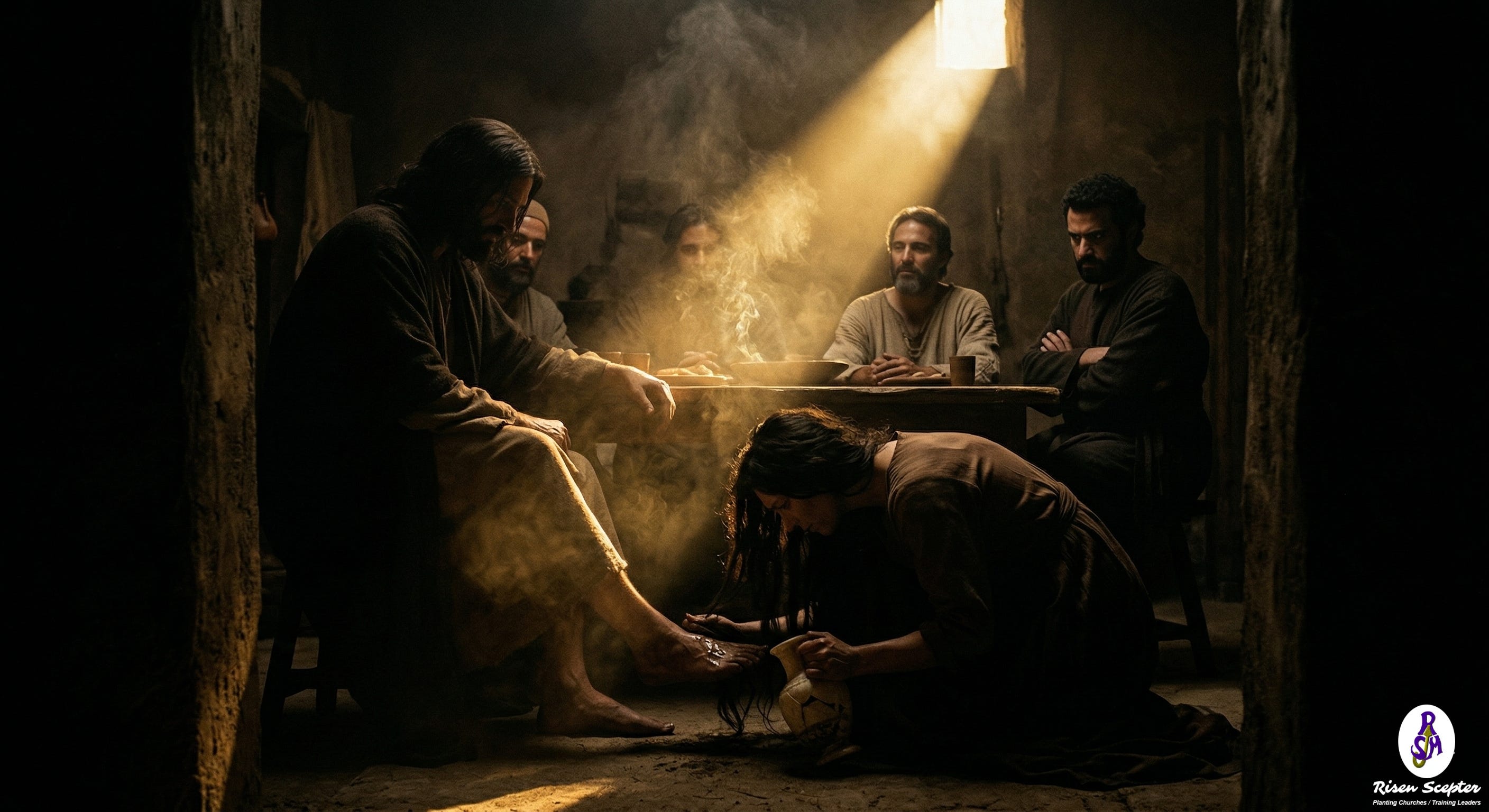
Six days before the Passover, Jesus returned to the home of Lazarus. During a meal, Mary took a pound of expensive ointment made from pure nard and anointed Jesus’ feet.
This was an act of staggering sacrifice. The nard was worth three hundred denarii—a full year’s wages. In that culture, such a treasure was often a family heirloom passed down through generations as a dowry or primary security. To break that jar was to pour out her entire future.
In an encounter of deep spiritual intimacy and humility, Mary wiped His feet with her hair.
In the first century, for a woman to unbind her hair in public was an act of total self-abandonment; she was laying her “glory” at His feet. Historically, while guests were offered water for their feet, anointing the feet with such costly oil was a rarity reserved for the highest royalty.
The Body as the Fragrant House
John records that “the house was filled with the fragrance of the perfume” (Jn 12:3). This is a profound spiritual type: the physical house was filled, just as ultimately, the Body of Christ becomes a house filled with fragrance through the indwelling Holy Spirit.
The scent of the nard was inescapable in that home, and so, the indwelling Spirit is the unmistakable “atmosphere” of the believer. We do not just dwell in God’s presence in buildings that are sacred spaces; we carry it, because we have become the true sacred space.
This fragrance produced two opposite reactions: to Mary, it was worship; to Judas, it was “waste.”
Listen to what the Apostle Paul proclaimed to the believers in Corinth.
2 Corinthians 2:15–16 (ESV)
15 For we are the aroma (the fragrance) of Christ to God among those who are being saved and among those who are perishing, 16 to one a fragrance from death to death, to the other a fragrance from life to life. Who is sufficient for these things?
Here again, we see two different reactions to one fragrance. The determining factor is the spiritual condition of those here the message. This is an either/or situation. There is no neutral position. Either someone receives the message and therefore receives life, or another rejects the message and receives the result of sin and therefore receives death. Here again, Jesus is the hinge pin.
The Triple Triumph: Hebrew, Greek, and Roman
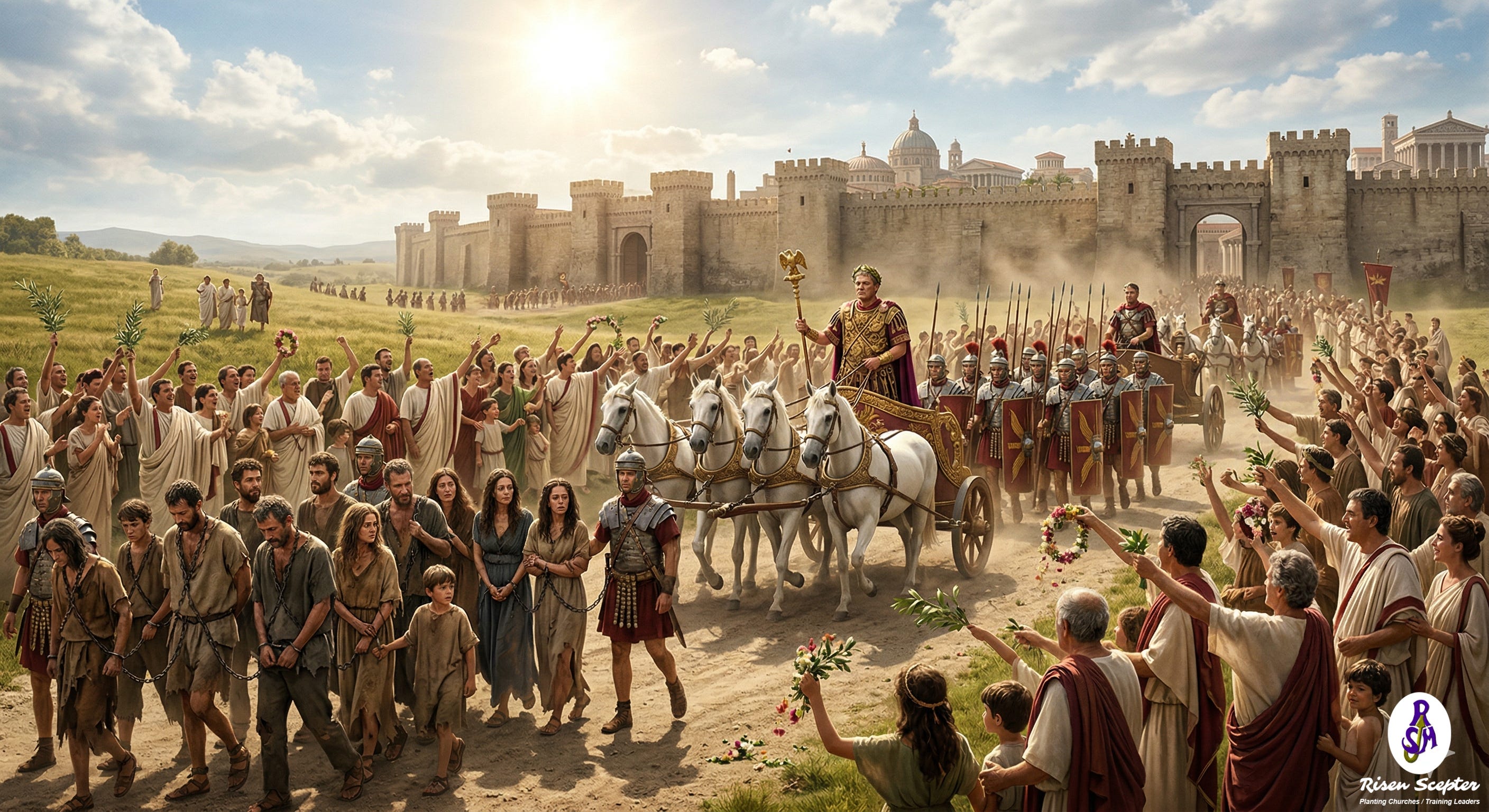
When Jesus finally approached the gates of Jerusalem, the air was thick with the expectations of three different worlds.
1. The Hebrew Celebration (The Feast of Booths)
The crowd’s use of palm branches and the cry of “Hosanna” (Save us, we pray!) was a direct callback to the Feast of Tabernacles and Psalm 118, verse 26. To the Hebrew mind, this was the “Lulav” celebration, which is Sukkot, the Feast of Booths—a recognition that the Messiah had come to dwell among them and deliver them from national bondage.
2. The Greek Expectation (The Epiphany)
The Greeks in the crowd would have recognized this as a Parousia or an “Epiphany”—the arrival of a god-king to a city. In Greek tradition, when a ruler visited, the city beautified itself and met him outside the gates. This explains why the “whole world” (the Gentiles) was drawn to this specific moment.
3. The Roman Triumphus
As we have noted, the Apostle Paul later used this visible key to explain the cross (triumphed over them in it; Col. 2:15). In a Roman Triumphus, citizens poured outside the gates to welcome a conquering general. The general rode in a chariot of honor, while the leaders of the conquered nations were marched in front of him in chains and open shame.
The Prophetic Enactment: Divesting the Enemy
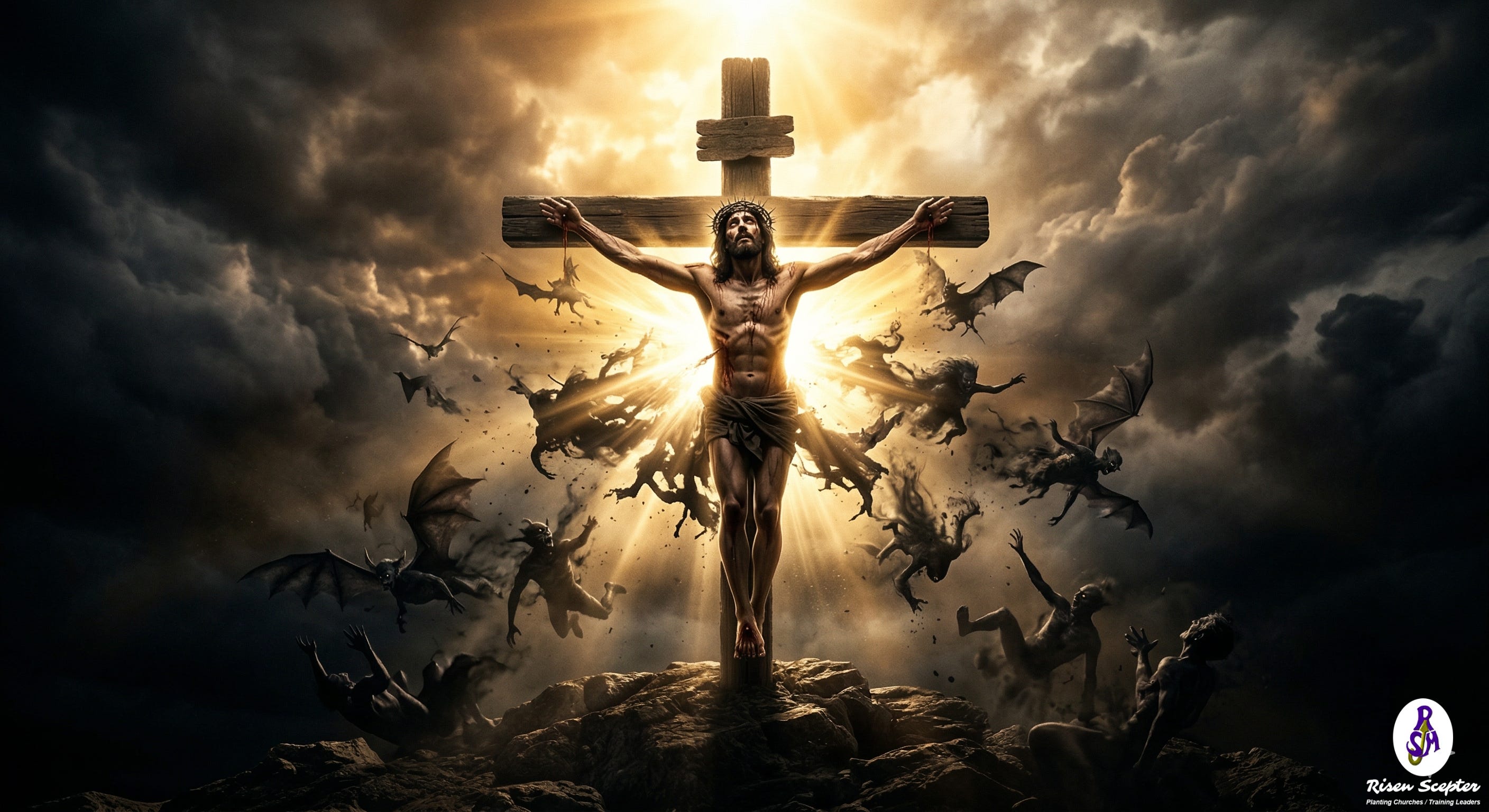
This Roman imagery was the fulfillment of a deep prophetic promise. Paul links this victory to Psalm 68:18, which describes God as a conquering King: “You ascended on high, leading a host of captives in your train.” Paul then applies this specifically to Christ in Ephesians 4:8.
8Therefore it says, “WHEN HE ASCENDED ON HIGH, HE LED CAPTIVE A HOST OF CAPTIVES, And HE GAVE GIFTS TO MEN.”
In Colossians 2:15, we see the mechanism of this victory. In the ESV, a marginal note suggests that Jesus “divested (rid)” Himself of the minions of the enemy. It is a cinematic image: as He hung on the Cross, the powers of darkness clung to Him like a heavy, suffocating coat, believing they had finally snared the King of Glory. However, by accomplishing exactly what He had been sent to do and satisfying the justice of God, the Cross broke their legal power. Jesus threw His arms open and cast the enemy off with ease, stripping them of their authority.
The Resurrection then served as the public proof of this “Prophetic Enactment.” As Paul claimed, He was raised because of our justification (Rom 4:25). The Resurrection was not merely a miracle; it was the King’s declaration that the enemies of God had been destroyed and His people were now legally free.
The Final Welcome: A Correction of Vision
In 1 Thessalonians 4:13-17, Paul took this “triumphal” imagery and applied it to the ultimate hope of the church.
To understand this passage, we must see the historical context of the church in Thessalonica. Paul was writing to a community in the grip of deep grief. Several members of the body had recently died, and the survivors were mourning because they feared their loved ones had “missed” the great return of Christ. They believed that because these believers had died before the King’s arrival, they would be excluded from the glory of the Resurrection.
Paul’s aim in writing was to bring comfort to these grieving hearts. He begins in verse 13 by addressing their misunderstanding of the state of the dead, and assures them that those who have “fallen asleep” will certainly be included. He then uses the specific word Apantēsis for “meet” (v. 17).
In the ancient world, apantēsis was the technical term for a formal delegation leaving their city to meet a visiting king and immediately escorting him back in honor. Paul’s message stated clearly: your loved ones are not lost! They will rise first, and together we will go out as one royal delegation to meet the King in the air—not to flee into the clouds, but to join His triumphal procession as He returns to claim and rule the Earth.
Conclusion: The Glorious Kingdom
The story began with a humble entry on a donkey, which was a prophetic enactment (Zech. 9:9), but the raising of a dead man and an anointing that cost a family their fortune preceded it. The cross, which was actually a coronation and a triumph, led to the enemy’s open shame.
Jesus will return in triumph, and ultimately, He will eradicate all that offends. The King Himself described the finality of this victory:
Matthew 13:41–43 (ESV)
“41 The Son of Man will send his angels, and they will gather out of his kingdom all causes of sin and all law-breakers, 42 and throw them into the fiery furnace. In that place there will be weeping and gnashing of teeth. 43 Then the righteous will shine forth like the sun in the kingdom of their Father. He who has ears, let him hear.”
The righteous will no longer be hidden, but will shine forth like the sun in the kingdom of their Father.
Drilling for Depth: Study Questions
Identity: How does the absolute use of Ego Eimi (I AM) in John 11:25 change how you view Jesus’ authority?
Sacrifice: Mary gave her “future security” to anoint Jesus’ feet. What is the “family heirloom” you are being asked to lay at His feet?
The Triple Crown: How does seeing Jesus as the fulfillment of Hebrew, Greek, and Roman expectations change your view of His global Lordship?
The Chariot: If Jesus “divested” Himself of the enemy on the Cross, why do we often live as if those powers are still clinging to us?
The Welcome: How does the historical grief of the Thessalonians and the concept of Apantēsis (escorting the King) change your hope for those who have died in Christ?