

The Proof of Weakness and Inability

Who is sufficient for These Things? Part 7
A Series on Our Attitude Toward Serving God – Servanthood – and Personal Growth
(Check out the rest of the series. You can find the series index here)
Primary Series Passage
“But thanks be to God, who in Christ always leads us in triumphal procession, and through us spreads the fragrance of the knowledge of him everywhere. For we are the aroma of Christ to God among those who are being saved and among those who are perishing, to one a fragrance from death to death, to the other a fragrance from life to life. Who is sufficient for these things?”
2 Corinthians 2:14–16, ESV
In the previous parts of this series, we looked at two proofs that make an authentic Christian ministry evident: the proof of integrity and character, followed by the proof of transparency and openness. Paul conducted his ministry openly before God and the people he served, allowing for examination. He didn’t distort the Word or conceal his motives, nor did he rely upon underhanded methods to obtain results.
We now come to another proof, one that stands in direct opposition to the way the world usually measures effectiveness.
The Proof of Weakness and Inability.
Those who opposed Paul used his lack of personal stature to argue that his service was devoid of genuine authority. They wanted the Corinthians to believe that a genuine servant of God should appear impressive and self-sufficient, with enough personal strength and speaking ability to command the admiration of others.
Paul didn’t answer their accusation by pretending to be stronger than he was. Instead, he acknowledged his weakness and explained why it was one of the clearest demonstrations that the power working through him belonged to God.
Before Paul speaks directly about human weakness, however, he establishes the surpassing glory of the treasure entrusted to weak human vessels.
The Glory of the New Covenant
In 2 Corinthians chapter 3, Paul contrasts the glory of the Old Covenant with the far greater glory of the New Covenant.
“The old way, with laws etched in stone, led to death, though it began with such glory that the people of Israel could not bear to look at Moses’ face. For his face shone with the glory of God, even though the brightness was already fading away. Shouldn’t we expect far greater glory under the new way, now that the Holy Spirit is giving life?”
2 Corinthians 3:7–8, NLT
The Old Covenant functioned as a ministry of condemnation because it effectively exposed the depth of human transgression. It held every soul accountable to the absolute standard of divine holiness, yet the failure did not reside within the law itself. Indeed, the law served as a reflection of God’s own righteous character; the crisis arose because fallen humanity lacked the capacity to satisfy its perfect requirements.
Yet even the covenant that exposed sin came with extraordinary glory. When Moses descended from the presence of God, his face reflected that glory so intensely that the people of Israel couldn’t bear to look at him.
Even then, the brightness was already beginning to fade.
Paul uses that fading glory to direct us toward something far greater. If a covenant that exposed sin and brought condemnation came with glory, how much greater must the glory be under the New Covenant, through which the Holy Spirit gives life?
Paul continues:
“Whenever someone turns to the Lord, the veil is taken away. For the Lord is the Spirit, and wherever the Spirit of the Lord is, there is freedom. So all of us who have had that veil removed can see and reflect the glory of the Lord. And the Lord—who is the Spirit—makes us more and more like him as we are changed into his glorious image.”
2 Corinthians 3:16–18, NLT
The contrast between these two covenants is deliberate.
Under the Old Covenant, the glory faded. Under the New Covenant, the glory continues to increase.
The Old Covenant became a ministry of condemnation because it held people accountable for their sins. The New Covenant is the ministry of righteousness, possessing a glory that far exceeds what came before it.
That which once possessed an extraordinary measure of brilliance now appears to have no glory at all, for a splendor that is far more profound has eclipsed it. The previous covenant possessed only a transitory glory, while the New Covenant features an enduring and eternal glory.
Paul says that a veil remains over the hearts of those who continue to look to the Old Covenant without seeing its fulfillment in Christ. They can’t see that its glory was fading or that it pointed beyond itself to something greater.
But when someone turns to the Lord, He removes that veil.
Those who’ve had the veil taken away can now see the glory of the Lord. As the Holy Spirit works within them, they also reflect His glory and are increasingly conforming to the image of Christ.
This transformation isn’t the product of human effort. It is the work of God.
God Shines His Light Into Our Hearts
Paul carries this thought directly into Chapter 4:
“For God, who said, ‘Let there be light in the darkness,’ has made this light shine in our hearts so we could know the glory of God that is seen in the face of Jesus Christ.”
2 Corinthians 4:6, NLT
Paul compares God’s act of speaking light into existence at creation with the light He causes to shine within the human heart.
In the beginning, darkness covered the earth until God spoke and declared, “Let there be light.” In the same way, spiritual darkness remains over the human heart until God acts sovereignly and causes the light of Christ to shine within us.
We didn’t produce that light, and we didn’t awaken ourselves from spiritual darkness. God shone the light of His glory into our hearts, revealing His glory in the face of Jesus Christ so we could know it.
It is a sovereign act of God that enables us to welcome and receive the good news of Christ. This knowledge of Christ is the rich deposit that dwells within every believer.
The Expositor’s Bible Commentary explains Paul’s meaning:
“Paul now states the reason why he preached Christ and served the Corinthians. It was because God had dispelled his darkness by illuminating his heart and had given him a knowledge of Christ he wished to share (cf. Acts 9:15; 26:16, 18; Gal. 1:15, 16).
“In the second creation, as in the first, darkness is dispersed and light is created by divine intervention, but in one case it was a personal word: ‘Let there be light’ (Gen. 1:3, which is expanded by Paul on the basis of Gen. 1:2); in the other case it was a personal act: ‘God shone in our hearts’ (cf. 1 Peter 2:9).”1
Paul was undoubtedly alluding to his own experience on the road to Damascus. He had been walking in spiritual darkness, convinced that he was serving God while persecuting the followers of Jesus. Then the risen Christ revealed Himself, and the light of God broke through Paul’s darkness.
Paul knew from personal experience that spiritual illumination was the work of God.
After establishing the greatness of this divine work, Paul makes one of the most important statements in the letter.
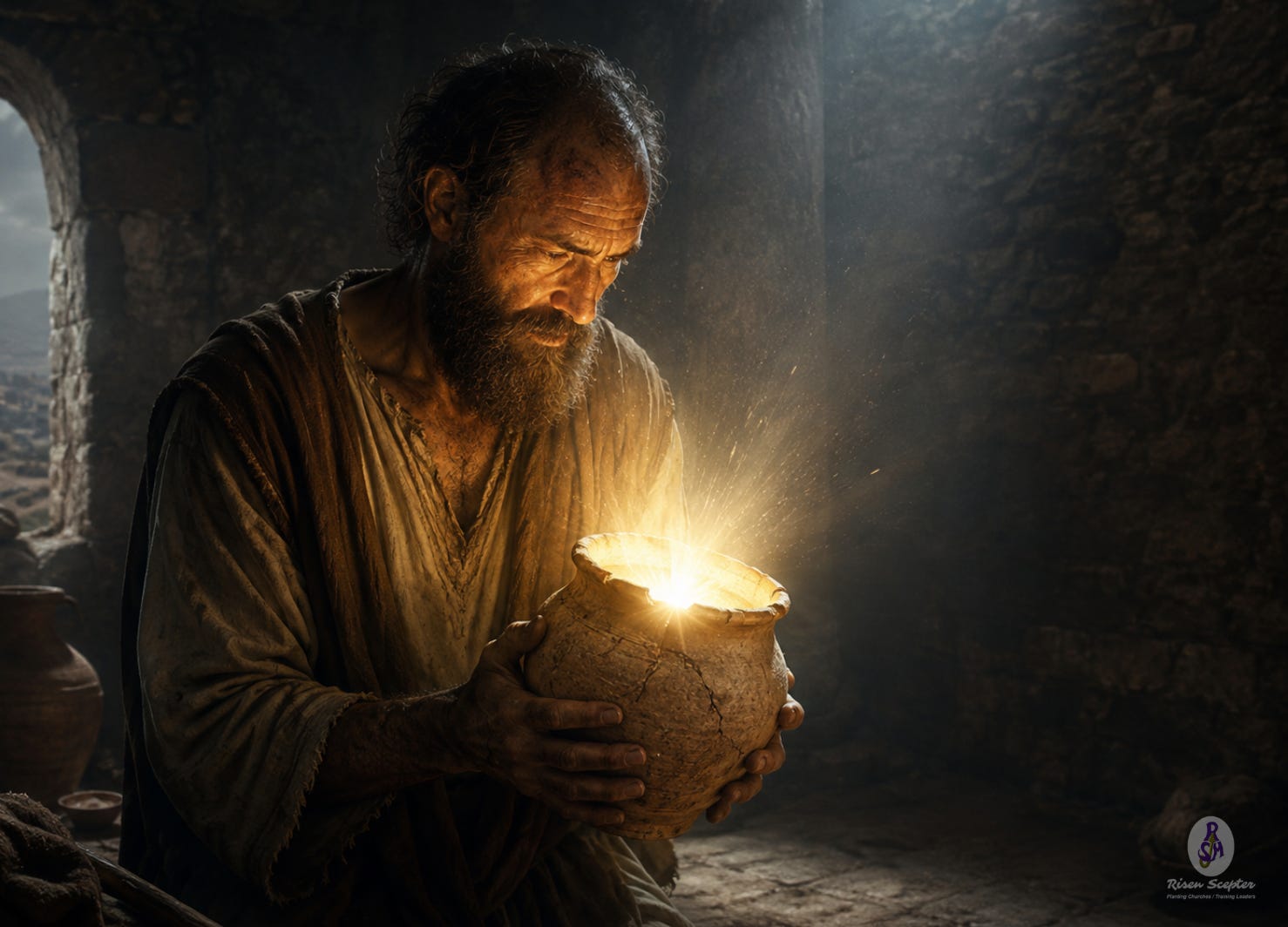
This Treasure in Jars of Clay
“But we have this treasure in jars of clay, to show that the surpassing power belongs to God and not to us.”
2 Corinthians 4:7, ESV
The New Living Translation puts it this way:
“We now have this light shining in our hearts, but we ourselves are like fragile clay jars containing this great treasure.”
2 Corinthians 4:7, NLT
The Today’s English Version reads:
“Yet we who have this spiritual treasure are like common clay pots, in order to show that the supreme power belongs to God, not to us.”
2 Corinthians 4:7, TEV
Paul also uses the vessel analogy in his second letter to Timothy:
“Now in a great house there are not only vessels of gold and silver but also of wood and clay, some for honorable use, some for dishonorable.”
2 Timothy 2:20, ESV
We have to allow the contrast in 2 Corinthians 4:7 to settle deeply within our hearts.
On the one hand, we’ve received a treasure of immeasurable value. We have the light of the knowledge of the glory of God in the face of Jesus Christ. We have the message of the New Covenant, the gospel through which the Holy Spirit gives life.
Nevertheless, God has sovereignly deposited this priceless treasure within common jars of clay. The treasure is glorious, but the vessels are fragile.
The IVP Bible Background Commentary explains:
“‘Earthen’ or ‘clay’ jars, as opposed to bronze ones, were readily discarded; because clay was always available, such containers were cheap and disposable if they were broken or incurred ceremonial impurity—an odd container for a rich treasure.”2
A clay pot wasn’t impressive. It wasn’t rare or costly. Clay was readily available, and clay vessels were common household objects. If one broke, another could easily take its place. That made the clay jar an unusual container for something precious. Yet that is exactly Paul’s point.
God has deliberately placed His priceless treasure within ordinary human vessels that are easily broken. The Greek word translated “clay” speaks of something highly fragile.
The Exegetical Dictionary of the New Testament states that it may refer to:
“The weak and fragile body of the apostle as a ‘vessel’ of the new ministry of glory.”3
MacArthur further describes the image:
“The Greek word means ‘baked clay,’ and refers to clay pots. They were cheap, breakable, and replaceable, but they served necessary household functions.
“…Sometimes they were used as a vault to store valuables, such as money, jewelry, or important documents. But they were most often used for holding garbage and human waste. The latter is the use Paul had in mind, and it was how Paul viewed himself—as lowly, common, expendable, and replaceable.”4
Paul wasn’t attempting to elevate himself before the Corinthians. He wasn’t trying to prove that he was more impressive than his opponents. He saw himself as a common vessel carrying an incomparable treasure. The value was in what God had deposited within him, not in the vessel itself.
The Surpassing Power Belongs to God

Paul tells us exactly why God has placed this treasure in jars of clay: it is “to show that the surpassing power belongs to God and not to us.”
The power that saves doesn’t originate with the preacher. Human eloquence can’t open blind eyes, and personality can’t produce spiritual life. The power belongs to God.
Our actions don’t contribute to this new life. We are breakable vessels with no ability to save ourselves. We couldn’t cause the light of God to shine into our own hearts, and we can’t cause it to shine into the hearts of others.
We carry the message faithfully, but God gives life.
That is why Paul asked:
“Who is sufficient for these things?”
2 Corinthians 2:16
Who is adequate to carry the fragrance of the knowledge of Christ throughout the world?
Who is sufficient to bear a message that becomes the fragrance of life to some and the fragrance of death to others?
None of us can produce eternal life in another person.
The weakness and limitation that belong to our common humanity ensure that the glory goes to God. He rules over all and deserves the honor for the creative work of salvation He brings about through His servants.
Paul heard the Lord tell him:
“My grace is sufficient for you, for my power is made perfect in weakness.” Therefore I will boast all the more gladly of my weaknesses, so that the power of Christ may rest upon me.
2 Corinthians 12:9, ESV
Paul did not find sufficiency within himself. It was found in the grace of Christ.
The Lord didn’t tell Paul that his weakness was imaginary or that he should disguise his limitations. He told him that divine grace was sufficient and that Christ’s power would be brought to its intended expression through weakness.
Therefore, Paul could acknowledge his weakness gladly because it became the setting in which the power of Christ rested upon him.
“…therefore, I will rather boast in my weaknesses, so that the power of Christ may dwell in me. 2 Co 12:9 LSB
This was one of the clearest distinctions between Paul and his opponents.
Paul’s opponents boasted of their ability, while Paul openly acknowledged his inability. They brought letters of commendation to establish their authority. Paul pointed to the transformed lives of those he had led to Christ.
The false apostles presented themselves as strong and sufficient. Paul found his sufficiency in Christ.
They wanted the Corinthians to be impressed with the messenger. Paul wanted them to see the glory of the One whose message he carried.
This didn’t mean that Paul’s life was free from trouble. His weakness became especially apparent under the severe pressure he experienced while serving the Lord.
In 2 Corinthians 4:8–9, Paul gives four contrasting examples:
“We are often troubled, but not crushed; sometimes in doubt, but never in despair; there are many enemies, but we are never without a friend; and though badly hurt at times, we are not destroyed.”
2 Corinthians 4:8–9, TEV
Trouble had affected Paul, but it did not crush him. He had experienced doubt and perplexity without being driven to despair. Though surrounded by enemies and badly hurt, God had not abandoned him or allowed him to be destroyed.
The trials Paul experienced didn’t make him ineffective for the kingdom. They drove him into a deeper dependence upon Christ and became part of the process through which God strengthened His servant.
As we acknowledge our weaknesses, we learn to rely upon Christ’s strength. In that way, the glory goes to God.
The treasure remains secure, despite the damaged vessel. Human weakness can’t destroy the gospel or diminish the power of the One who placed it within us.
Paul’s Understanding of Weakness
The apostle uses the Greek word astheneia, along with other words from the same word group, fourteen times in 2 Corinthians. The word speaks of feebleness or frailty.
Paul understood weakness as a reality of human life.
When describing the contrast between the natural body and the resurrected body, he writes:
“It is sown in dishonor; it is raised in glory. It is sown in weakness; it is raised in power.”
1 Corinthians 15:43, ESV
Weakness marks our present bodies. They become tired, suffer illness, and eventually die. However, God will raise the resurrected body in power.
Paul also spoke openly about his own human frailty when he reminded the Corinthians of how he first ministered among them:
“And I was with you in weakness and in fear and much trembling.”
1 Corinthians 2:3, ESV
Paul didn’t arrive in Corinth projecting an image of effortless confidence. He became conscious of his own weakness, feeling fear and trembling, yet he remained faithful in proclaiming Christ.
The power of his ministry did not reside in an impressive public image. His ministry's power came from the God who worked through him.
Paul even compared our human frailty and the weakness Christ experienced in His humanity:
“Although he was crucified in weakness, he now lives by the power of God. We, too, are weak, just as Christ was, but when we deal with you we will be alive with him and will have God’s power.”
2 Corinthians 13:4, NLT
Christ suffered crucifixion in weakness, yet He now lives by God's power.
Likewise, Paul acknowledged that he and his companions were weak. Nevertheless, they would live with Christ and minister through the power God supplied.
Weakness didn’t mean the absence of divine power. It became the place that revealed divine power.
Weakness as Proof of Genuine Ministry
When Paul spoke about his weakness and the frailty of human life, he was drawing a direct contrast between himself and his opponents.
In Paul’s absence, they had told the Corinthians that the apostle was weak and therefore ineffective in ministry. They claimed that his bodily presence was unimpressive and that his speaking ability was of little value.
Paul could’ve responded by attempting to prove that he was stronger than they were. He didn’t.
Rather than refuting their accusation, he expanded upon it and agreed with them.
In effect, Paul said, “Yes, they are right. I am weak, as we all are. Yet that weakness provides the setting in which the power of Christ works through my life. What you’re seeing isn’t my power. It is Christ working through me.”
That was one of the pieces of evidence that Paul’s ministry was genuine.
The false apostles boasted in themselves, but Paul gloried in Christ. They directed attention toward their own sufficiency, while Paul asked, “Who is sufficient for these things?”
They wanted others to admire the vessel. Paul wanted the Corinthians to understand the immeasurable value of the treasure God had placed within it.
We are all feeble. We are frail and weak, with no sufficiency in ourselves for the work God has entrusted to us.
Yet we aren’t to despair over these truths. We are to rejoice because it is God’s pleasure to accomplish His purposes through people who know they’re unable to accomplish those purposes apart from Him.
Our weakness leads us away from confidence in ourselves and toward dependence upon Christ. His grace is sufficient, and His strength is revealed through the fragile vessels He has chosen to use.
When that happens, God receives the glory.
A Shepherd’s Reflection
One of the greatest dangers we face is believing that God is waiting for us to become stronger before He can truly use us. We quietly imagine that if we possessed greater wisdom, more confidence, or more ability, then we would finally become useful in His kingdom. Yet Paul learned exactly the opposite.
The weakness of His servants has not limited the Lord. He has only been hindered by their unwillingness to depend upon Him.
That is both humbling and wonderfully encouraging.
It means that our usefulness in God’s Kingdom is not determined by the measure of our natural abilities but by the depth of our dependence upon Christ. The more we recognize that we can do nothing apart from Him, the more room there is for His grace to accomplish what we never could.
This truth ought to reshape the way we think about ministry.
Instead of asking, “Am I capable enough?” Perhaps we should ask, “Am I depending upon Christ enough?” Those are very different questions.
Servants eventually discover that God never intended for them to live the Christian life using only human strength. The Lord intentionally leads us into situations that remind us of our inability so that we will learn to lean more fully upon Him. He is not trying to discourage us. He is showing us where we can find true strength.
Perhaps today you feel like a fragile clay vessel. You see your weaknesses far more clearly than your strengths. You wonder whether the Lord could really accomplish anything through someone as ordinary as you.
Take courage.
The treasure has never depended on the vessel; it has always depended on the greatness of the One who placed it there.
Our weakness does not diminish His glory. When surrendered to Him, it becomes another opportunity for His power to be displayed.
That is why Paul could honestly ask, “Who is sufficient for these things?” and then quietly answer the question through the testimony of his own life.
We have never found our sufficiency in ourselves. Rather, our sufficiency is from God.

Scriptures for Further Study
One of the themes running throughout Paul’s ministry is that God delights in displaying His strength through those who recognize their complete dependence upon Him. The following passages continue to develop that truth.
2 Corinthians 3:4–6
Paul has already answered the question that forms the theme of this series. Through Christ, we direct our confidence toward God, and we have always found our sufficiency in Him, not in ourselves.
2 Corinthians 12:7–10
Later in this same letter, Paul explains that he learned to rejoice even in weakness because God’s grace proved sufficient and Christ’s power was perfected there.
1 Corinthians 1:26–31
God intentionally chooses what the world considers weak, foolish, and insignificant so that no one may boast before Him. Every servant is reminded that all glory belongs to God alone.
John 15:4–5
Jesus teaches that lasting spiritual fruit is never produced through human effort. Apart from Him we can do nothing of eternal value.
Philippians 3:3–9
Paul willingly abandoned every earthly credential because he discovered that knowing Christ was of infinitely greater value than trusting in himself.
Isaiah 40:28–31
Those who acknowledge their need and wait upon the Lord discover that He supplies strength they could never produce on their own.
Psalm 121:1–2
Our help has never come from ourselves. It comes from the Lord, the Maker of heaven and earth.
Reflection Questions
As you spend time with the Lord, prayerfully consider the following questions.
Have you ever allowed your weaknesses to convince you that God could not use you? How does Paul’s teaching challenge that conclusion?
In what areas of your life are you most tempted to rely upon your own abilities rather than upon the grace of Christ?
How does the illustration of the treasure in jars of clay change the way you think about Christian ministry?
If someone observed your life, would they leave more impressed with your abilities, or with the greatness and faithfulness of Christ?
What practical steps can you take this week to cultivate greater dependence upon the Lord in your daily walk and service?
Next Time
Paul has shown us that genuine servants do not hide their weakness because they understand that God’s power is displayed most clearly through lives that are wholly dependent upon Him. In Part 8 of Who Is Sufficient for These Things?, we’ll continue following Paul’s defense of authentic ministry as he presents another evidence of a sincere servant’s heart and further exposes the vast difference between those who seek to exalt themselves and those who faithfully exalt Christ.

Join the Mission
Jesus Christ calls every believer to deny himself, take up his cross, and follow Him. Yet He never asks us to endure or sacrifice anything that He Himself has not already endured—and infinitely more. His perfect obedience to the Father remains the pattern for every servant who desires to follow Him faithfully.
If this article has encouraged or challenged you, would you consider sharing it with someone who desires to know God’s Word more deeply? I also invite you to subscribe and continue with us through this series as together we seek to know Christ more deeply, faithfully handle His Word, and grow into mature disciples who bring glory to God.
Your prayers, encouragement, and support also help Risen Scepter Ministries International continue equipping pastors, strengthening churches, planting congregations, and serving vulnerable communities throughout developing nations.
About Risen Scepter Ministries International
Risen Scepter Ministries International exists to express the Kingdom of God in the earth by equipping pastors in developing nations so that they, in turn, may equip their people for the work of the ministry, according to Ephesians 4:11–13.
Through biblical leadership training, church planting, pastoral encouragement, theological instruction, and ministry among vulnerable communities, we seek to strengthen Christ’s Church through a faithful exposition of God’s Word. Our desire is to help form believers who firmly establish their lives upon Scripture. They will discern truth from error, endure suffering without abandoning their faith, and remain steadfast in Christ until the consummation of all things.
Visit us on the web at RisenScepter.org
Editorial Note
My own biblical studies, live seminars and teaching events, and years of pastoral ministry provided the basis for these articles. I use AI solely as an editorial and organizational assistant to help prepare these teachings for publication while preserving my voice and style. The biblical teaching, theological convictions, ministry experiences, and pastoral perspective expressed here are my own, and every article is personally reviewed, edited, and approved by me before publication. My desire in every article is to faithfully handle God’s Word, equip the Church, and point readers to Jesus Christ.
Murray J. Harris, “2 Corinthians,” in The Expositor’s Bible Commentary: Romans–Galatians (Revised Edition), ed. Tremper Longman III & Garland, David E., vol. 11 (Grand Rapids, MI: Zondervan, 2008), 467.
Craig S. Keener, The IVP Bible Background Commentary: New Testament (Downers Grove, IL: InterVarsity Press, 1993), 2 Co 4:7.
Horst Robert Balz and Gerhard Schneider, Exegetical Dictionary of the New Testament (Grand Rapids, Mich.: Eerdmans, 1990–), 538.
John F. MacArthur Jr., The MacArthur Study Bible: New American Standard Bible. (Nashville, TN: Thomas Nelson Publishers, 2006), 2 Co 4:7.
You are blessed 🙌
Who is sufficient for these things?”
2 Corinthians 2:16
☝️ wow 😃 who?