

The Proof of Transparency and Openness
Who Is Sufficient for These Things? — Part 6

Who Is Sufficient for These Things? — Part 6

(Check out the rest of the series. You can find the series index here)
Primary Series Passage
“For we are the aroma of Christ to God among those who are being saved and among those who are perishing, to one a fragrance from death to death, to the other a fragrance from life to life. Who is sufficient for these things?“ 2 Corinthians 2:15-16 (ESV)
Where We Have Been and Where We Are Going
As we continue our journey through the marks of authentic Christian ministry, we come to another unmistakable evidence of a sincere servant’s heart: transparency and openness.
In the previous article, we considered the importance of integrity and Christlike character. Integrity speaks of wholeness—a life in which the private person and the public servant are not fundamentally different. Transparency is the visible expression of that integrity. It allows others to see that there is no hidden machinery behind the ministry, no concealed agenda beneath the message, and no secret method being used to manipulate the people of God.
Something transparent allows light to pass through it so that what lies behind it may be clearly seen. In the same way, a transparent ministry does not depend upon concealment. It welcomes honest examination because it has determined to walk before God and people without deception.
The apostle did not claim perfection. Paul, however, insisted that he could bring his ministry into the light.
He had nothing to gain from hiding the truth, and nothing to protect through manipulation.
Ministry Conducted in the Sight of God
“But we have renounced disgraceful, underhanded ways. We refuse to practice cunning or to tamper with God’s word, but by the open statement of the truth we would commend ourselves to everyone’s conscience in the sight of God.”
— 2 Corinthians 4:2
Paul conducted his ministry with the continual awareness that he lived and served in the presence of God.
That conviction shaped everything.
He did not merely ask whether his methods would produce results. He asked whether they could withstand the examination of God. He did not measure faithfulness by popularity, influence, financial success, or the response of an audience. His concern was whether his words, motives, and methods were acceptable before the One who had called him.
Paul wrote:
“By the open statement of the truth we would commend ourselves to everyone’s conscience in the sight of God.”
That final phrase is essential: in the sight of God.
Paul was not performing transparency as a public-relations strategy. He was not attempting to appear sincere in order to gain the trust of the Corinthians. The deeper reality that God already observed his entire ministry caused his openness.
He perceives all; nothing remains hidden from Him.
God sees the motives beneath our words. He sees the ambition beneath our service. He sees whether we are preaching Christ or quietly building our own names. He sees whether we are protecting His people or using them to satisfy our need for significance, control, recognition, or financial gain.
A servant who genuinely lives before God does not need to manufacture an appearance of sincerity. The fear of the Lord produces honesty from within.
Renouncing Disgraceful and Underhanded Ways
Paul declared that he and his companions had “renounced disgraceful, underhanded ways.”
To renounce something is not merely to avoid it temporarily. It is to reject it decisively. Paul had turned away from the hidden practices that so often accompany human attempts to gain power and influence.
He refused cunning.
He refused manipulation.
He refused to handle the Word of God dishonestly.
When Paul came to Christ, he laid the methods of worldly advancement at the foot of the cross. He would not build the kingdom of God through the techniques of fallen humanity. He would not use deception in the service of truth. He would not distort Scripture in order to attract followers, protect his reputation, or produce the response he desired.
This remains one of the great temptations of ministry.
A leader may begin with a sincere desire to serve God, yet gradually become convinced that the desired outcome justifies questionable methods. People may exaggerate scripture to create excitement. They might embellish testimonies to provoke an emotional response. Financial needs may be presented in a way that pressures or frightens people. Prophetic claims may be used to control decisions. Discouraging questions protects the ministry’s carefully constructed image, as honest examination threatens it.
But truth does not require deception to support it.
God does not need manipulation to accomplish His purposes.
The servant of Christ must never believe that dishonesty becomes holy merely because it is practiced in the name of ministry.
The Open Statement of the Truth
Paul placed his confidence in “the open statement of the truth.”
He did not depend on hidden meanings, secret knowledge, calculated flattery, or carefully concealed motives. He spoke the truth plainly and entrusted the results to God.
This does not mean Paul’s teaching was shallow or simplistic. His letters contain some of the most profound theological reasoning found in scripture. Yet even when his teaching was deep, he did not conceal his purpose. He wanted people to know Christ, understand the gospel, grow into maturity, and live faithfully before God.
There was no second message beneath the first.
There was no private agenda concealed behind the public ministry.
Paul could essentially say to the Corinthians, “Look carefully. Examine our conduct. Listen to our message. You can see for yourselves that we are not operating through trickery or deceit.”
An authentic servant does not fear reasonable examination. Questions may sometimes be uncomfortable, and accusations may be unfair, as they certainly were in Paul’s life. Nevertheless, the genuine servant does not depend upon darkness for survival.
An authentic servant welcomes honest examination because their trust rests not in a manufactured appearance, but in the steadfast pursuit of walking before the Lord with sincerity.
The Shadows of the Super-Apostles
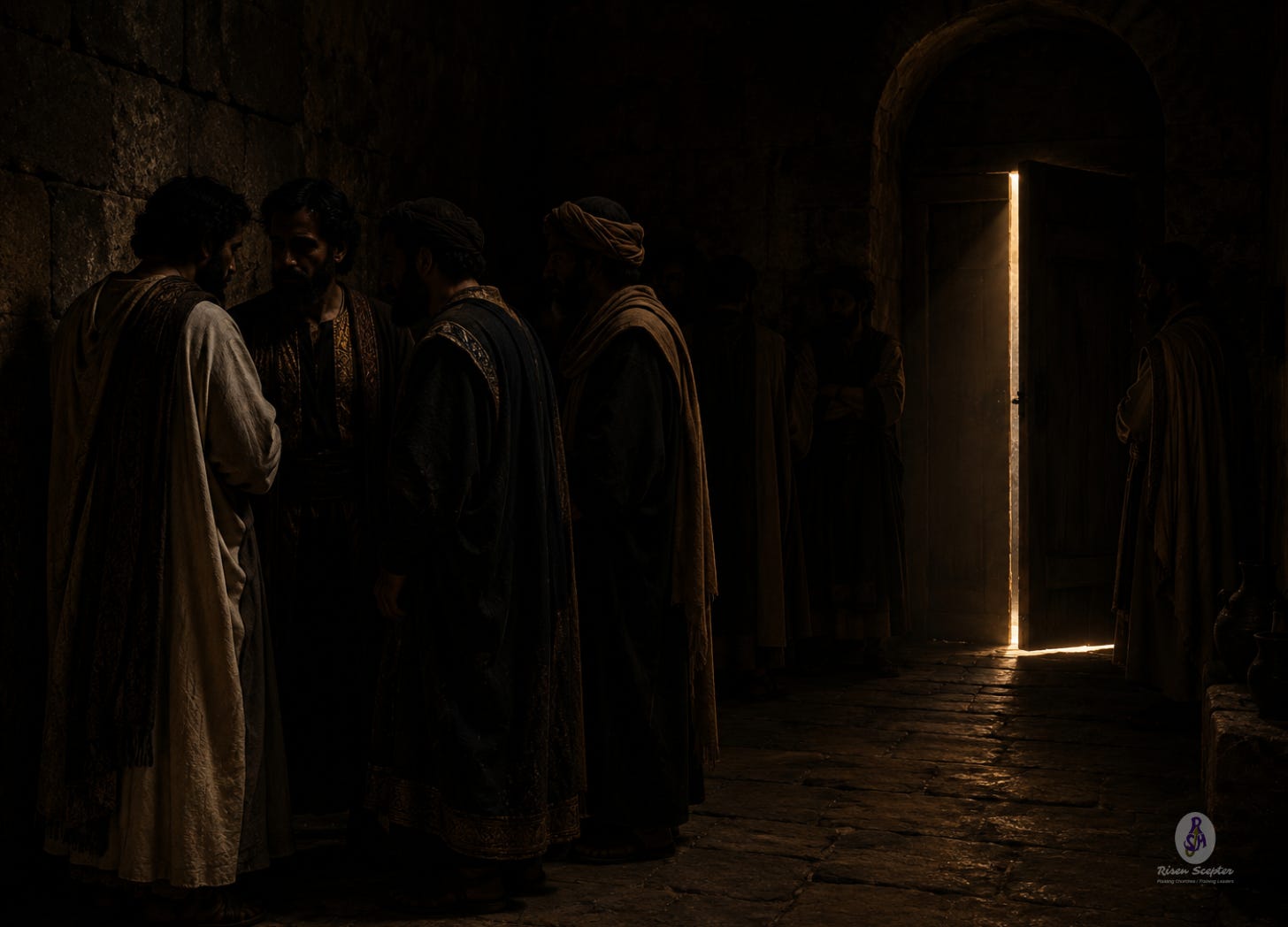
The openness of Paul’s ministry becomes even clearer when contrasted with the false apostles who were influencing the Corinthian church.
These men presented themselves as impressive spiritual leaders. They were polished, persuasive, confident, and outwardly successful. They boasted in their credentials and promoted themselves as superior to Paul. Yet beneath the appearance was deception.
Later in the letter, Paul described them plainly:
“For such men are false apostles, deceitful workmen, disguising themselves as apostles of Christ.”
— 2 Corinthians 11:13
Their ministry depended upon disguise.
They needed the people to see the mask rather than the person behind it. Their influence depended upon the shadows, for they knew that bringing their true intentions into the light would only demonstrate that their labor did not have Christ at its center. Their influence depended upon the Corinthians being impressed by the appearance and never examining what lay beneath it.
This is why false ministry often resists accountability.
Questions are interpreted as rebellion. Examination is portrayed as persecution. Leaders surround themselves with those who will protect their image rather than confront their conduct. Information is tightly controlled. Failures are concealed. Those who raise legitimate concerns may be silenced, discredited, or removed.
When a ministry must continually suppress the truth in order to preserve itself, it is no longer being preserved by God. It is being maintained through darkness.
The contrast could not be greater.
Paul brought his ministry into the light.
The false apostles required shadows.
Transparency Is Not the Absence of Wisdom
There is an important distinction we must make.
Authentic transparency does not demand that every intimate particular of a servant’s existence be broadcast for public consumption. It does not require leaders to violate confidences, expose their families, disclose matters that belong in private counsel, or share every thought and emotion with everyone.
Jesus Himself did not entrust Himself equally to all people. Paul sometimes withheld details when wisdom, safety, or the protection of others required it. Scripture honors discretion, confidentiality, and appropriate boundaries.
Transparency is not the abandonment of wisdom.
Rather, transparency means that what we do reveal is truthful. It means that we do not create false impressions, conceal wrongdoing, manipulate facts, or present ourselves as something we are not. It means that private boundaries are not used as hiding places for unrepentant sin, financial misconduct, spiritual abuse, or deception.
A servant may rightly say, “That matter is private.”
A servant must never use privacy to mean, “This must remain hidden because exposure would reveal dishonesty.”
There is a difference between confidentiality and concealment.
Confidentiality protects people.
Concealment protects deception.
Accountability as a Gift
True openness welcomes appropriate accountability.
This is not because faithful servants are incapable of failure. It is because they know they are capable of it.
No leader is beyond temptation. No calling eliminates human weakness. No spiritual gift makes accountability unnecessary. The greater the influence entrusted to a servant, the greater the need for relationships and structures that permit honest questions and correction.
Rather than resisting scrutiny, we should recognize that godly accountability serves as a vital safeguard for the servant of Christ. It is one of God’s protections for ministry.
Wise accountability can help guard doctrine, finances, personal conduct, relationships, and the use of authority. It can identify dangers before they become disasters. It can protect both the servant and the people entrusted to that servant’s care.
A leader who refuses all examinations is not demonstrating strength. He may create the very environment in which weakness can grow unchecked.
The transparent servant understands that correction is not always an attack, and questions are not always accusations. Sometimes they are instruments of God’s mercy.
Transparency in the Handling of Scripture
The apostle further insisted that this hallmark of transparency must extend beyond one’s behavior to the very manner in which the Word of God is handled.
He wrote:
“We refuse to practice cunning or to tamper with God’s word.”
The phrase translated “tamper with” carries the idea of adulterating, corrupting, or handling something deceitfully. Paul would not dilute the truth, alter its meaning, or blend it with error in order to make it more acceptable.
This is one of the clearest tests of spiritual integrity.
10 And the brothers immediately sent Paul and Silas away by night to Berea, and when they arrived, they went into the synagogue of the Jews. 11 Now these were more noble-minded than those in Thessalonica, for they received the word with great eagerness, examining the Scriptures daily to see whether these things were so.
Ac 17:10–11 LSB
Does the teacher allow Scripture to speak according to its context and intended meaning, or is the Bible used as raw material to support a predetermined message?
Are difficult passages taught honestly, or quietly avoided?
Are promises presented without their context?
Are emotional stories used to overpower careful examination of the text?
Does the preacher invite people to know the Word for themselves, or create dependence upon his supposed insight and authority?
Transparent teaching does not fear an open Bible.
It does not ask people to accept a claim merely because a respected leader has made it. It encourages believers to search the Scriptures, examine the context, and test what they hear.
The faithful teacher does not stand above the Word of God.
He stands beneath it.
When the Vessel Does Not Obstruct the Light
The imagery of transparency fits beautifully within Paul’s larger argument in 2 Corinthians.
In the following verses, Paul speaks of the light of the gospel and the glory of God revealed in the face of Jesus Christ. He then describes believers as fragile jars of clay carrying an immeasurable treasure.
The vessel is not the source of the light.
Christ is.
The servant’s responsibility is not to draw attention to the clay pot but to avoid obstructing the treasure within it. When ministry becomes consumed with the preservation of reputation, platform, personality, or image, the vessel begins to compete with the glory it was meant to carry.
But when a servant walks in humility, honesty, and openness, the light of Christ may be seen more clearly.
The purpose of transparency is not to place the servant at the center. It is to remove the coverings that prevent people from seeing Jesus.
We are not transparent so that everyone will admire our honesty.
We are transparent so that the surpassing power may be seen to belong to God and not to us.
The Danger of a Carefully Constructed Image
Modern ministry provides more opportunities than ever to create and manage a public image.
Through websites, social media, video, carefully selected photographs, testimonies, and promotional materials, a leader can present a version of ministry that appears far more successful, fruitful, or spiritually powerful than reality would support.
Communication and media are not inherently wrong. They can serve the gospel and help people understand what God is doing. The danger arises when presentation replaces truth.
It is possible to show crowds without showing disciples.
It is possible to report decisions without demonstrating lasting fruit.
It is possible to display generosity while concealing financial irresponsibility.
It is possible to speak constantly about humility while carefully cultivating personal celebrity.
It is possible to preach transparency while surrounding oneself with people who may never ask troublesome questions.
The temptation to construct an image is not limited to well-known ministries. It can enter a local church, a small organization, an online platform, or the heart of an individual believer. Wherever we become more concerned with how we appear than with who we are before God, deception has already begun its work.
The answer is not to withdraw from public ministry.
The answer is to remain deeply rooted in the presence of God, where the image we project can never hide the person we truly are.
A Ministry That Can Withstand the Light
The timeless lesson for the Church is not that every ministry should disclose everything to everyone. It is that no ministry should depend upon deception, manipulation, or concealed corruption.
A faithful ministry should be able to withstand the light.
Its doctrine should withstand biblical examination.
Its finances should withstand responsible accountability.
Its leaders should withstand honest questions.
Its methods should withstand moral scrutiny.
Its claims should withstand verification.
Its treatment of people should reflect the character of Christ.
Where failures occur, as they inevitably will among imperfect people, transparency includes confession, repentance, correction, and a willingness to make matters right.
The authentic servant does not claim never to have failed.
Rather than retreating into the shadows of dishonesty when shortcomings are revealed, the genuine minister remains steadfast in the light.
Final Pastoral Reflection
Every one of us must ask whether there are areas of our lives that we are trying to keep in the shadows.
Perhaps it is not public scandal. It may be a hidden motive, an exaggerated story, a carefully maintained appearance, an unwillingness to receive correction, or a habit of using spiritual language to conceal personal ambition.
We may successfully hide these things from people for a time.
We cannot hide them from God.
Yet the light of God is not given merely to expose and condemn. For those who come honestly before Him, His light also cleanses, restores, and makes us whole.
The answer to hiddenness is not the creation of a better mask.
It is repentance.
It is stepping into the light of God’s presence and allowing Him to bring our private lives, public words, ministry methods, and inward motives into agreement with the truth.
The genuine servant has no need to fear that light.
He knows that his sufficiency does not come from maintaining the appearance of perfection. His sufficiency comes from Christ.
Therefore, he can renounce disgraceful and underhanded ways. He can refuse cunning. He can handle God’s Word honestly. He can welcome godly accountability. He can speak the truth openly and entrust his life and ministry to the judgment of God.
A transparent ministry does not proclaim that the vessel is flawless.
It allows the world to see that the treasure belongs to God.
Next Time
In Part 7 of Who Is Sufficient for These Things?, we will continue examining the marks of authentic Christian ministry and the qualities that distinguish the genuine servant of Christ from those who misuse spiritual authority.

Scriptures for Further Study
1 John 1:5–9
God is light, and in Him there is no darkness. John connects fellowship with God to walking in the light, practicing the truth, confessing sin, and receiving cleansing.
Ephesians 5:8–14
Believers were once darkness but are now light in the Lord. Paul calls them to walk as children of light and to expose the unfruitful works of darkness.
Matthew 5:14–16
Jesus calls His followers the light of the world. Their lives are to be visible in such a way that others glorify the Father rather than the servant.
Romans 13:11–14
Paul urges believers to cast off the works of darkness, put on the armor of light, and make no provision for the desires of the flesh.
2 Corinthians 1:12
Paul appeals to the testimony of his conscience that he conducted himself with simplicity and godly sincerity rather than earthly wisdom.
2 Corinthians 2:17
Paul distinguishes his ministry from those who peddle the Word of God for profit, declaring that he speaks sincerely as one commissioned by God and standing in His presence.
2 Corinthians 4:1–7
The immediate context of this article: ministry received through mercy, the renunciation of hidden practices, the light of the gospel, and the treasure carried in jars of clay.
2 Corinthians 6:3–10
Paul describes the openness of his life and the endurance through which he commended himself as a servant of God.
2 Corinthians 7:2
Paul appeals to the Corinthians to open their hearts, declaring that he had wronged, corrupted, and taken advantage of no one.
2 Corinthians 8:20–21
Paul took deliberate precautions in administering financial gifts, seeking to do what was honorable not only before the Lord but also before people.
In 2 Corinthians 11:13–15
Paul identifies false apostles as deceitful workers who disguise themselves as apostles of Christ, mirroring Satan’s appearance as an angel of light.
Luke 12:1–3
Jesus warns against hypocrisy and declares that what is concealed will ultimately be revealed.
John 3:19–21
Those who practice evil avoid the light, while those who practice the truth come into the light so that it may be seen that their works have been carried out in God.
Hebrews 4:12–13
Nothing in creation is hidden from God. All things are exposed before the eyes of the One to whom we must give account.
James 3:1
Those who teach will be judged with greater strictness, making honesty and accountability especially important in Christian ministry.
1 Timothy 3:1–7
The qualifications for overseers emphasize observable character, maturity, self-control, faithfulness, and a good reputation.
1 Peter 5:1–4
Church leaders are commanded to shepherd willingly, without shameful gain or domineering conduct, becoming examples to the flock.
Reflection Questions
Is there any difference between the person I present publicly and the person I am privately before God?
Are there areas of my life or ministry in which I resist honest examination or godly accountability?
Do I ever exaggerate, omit important facts, or create a misleading impression in order to protect my reputation or produce a desired response?
When someone asks a sincere question about my teaching, decisions, or conduct, do I respond with humility or defensiveness?
Am I handling Scripture openly and honestly, allowing its context and meaning to govern my teaching?
Are the structures surrounding my ministry designed to provide genuine accountability, or merely to protect leadership from scrutiny?
Do I confuse appropriate privacy with the concealment of matters that should be confessed, corrected, or brought into the light?
Is there anything God is asking me to renounce so that the light of Christ may shine more clearly through my life?
When failure occurs, am I willing to confess, repent, and make matters right, or am I tempted to manage appearances?
Does my life direct attention toward Christ and the treasure of the gospel, or toward the image I have created of myself?

Join the Mission:
Jesus Christ calls us to lay down our lives, take up our cross, and follow Him. Yet, He never asks us to endure or sacrifice anything He has not already done Himself—and infinitely more. Christ’s perfect faithfulness and obedience to the Father’s will is the ultimate example for us to follow. If your heart is stirring to step away from man-centered religion and into a life of total surrender to the King, please share this post to challenge and encourage a fellow believer. Subscribe today to join our mission of equipping every member of the Body for authentic service in the harvest.
About Risen Scepter Ministries International:
Risen Scepter Ministries International (RSMI) is a non-profit organization dedicated to “Expressing the Kingdom of God in the Earth”. Our core vision is to equip pastors in developing nations so that they might in turn equip their people to do the work of the ministry, fulfilling the mandate of Ephesians 4:11-13.
Through biblical training centers, pastor support programs, and initiatives for at-risk children, we bring hope and resources to leaders serving Christ in non-industrialized nations—many of whom minister faithfully in the face of extreme poverty or persecution. We firmly believe that the Word of God and the correct application of biblical principles have the power to transform individuals, families, communities, and entire nations.