

He Is My Son: The Coronation of the King
His Resurrection and Ours

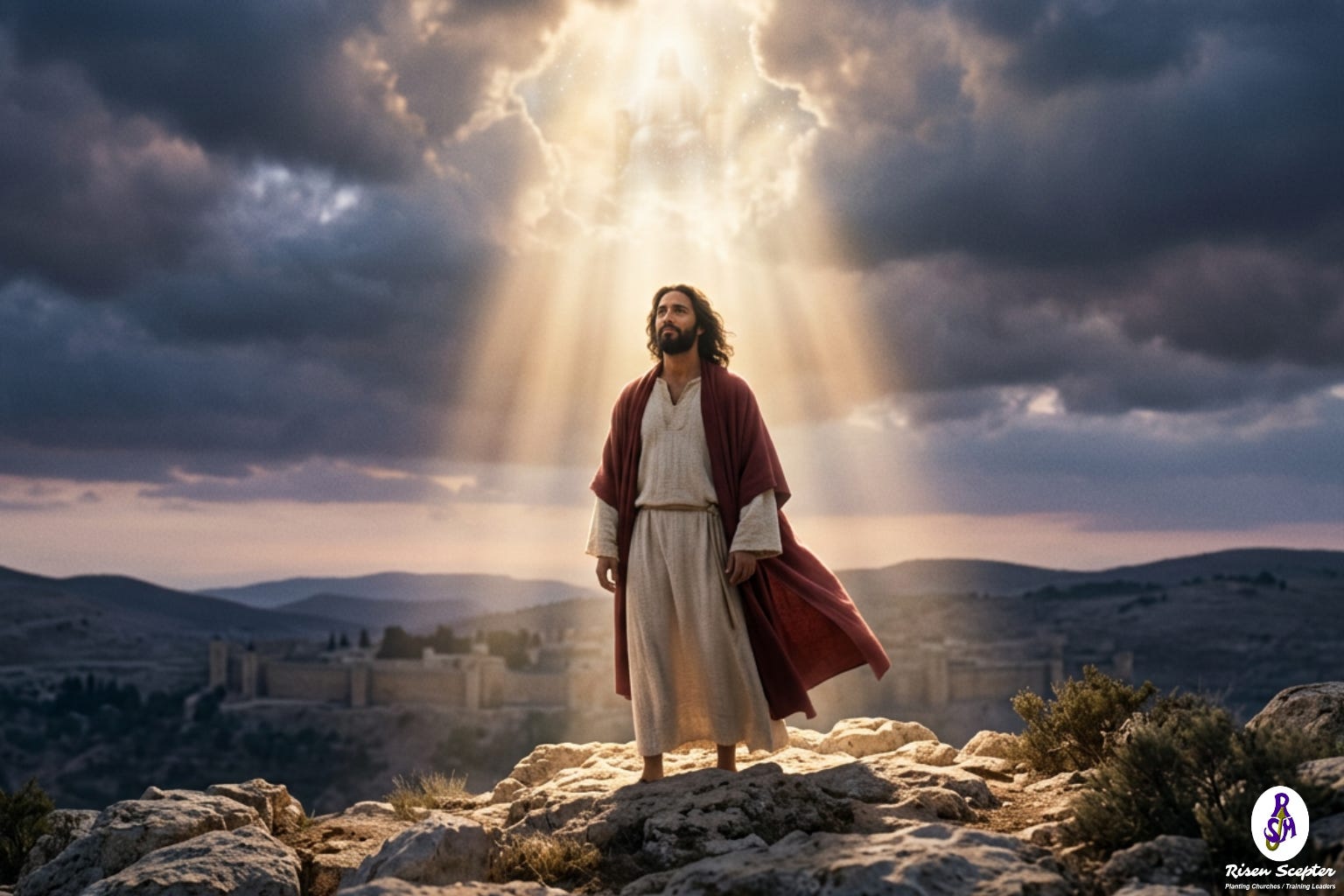
“But as for Me, I have installed My King Upon Zion, My holy mountain.” “I will surely tell of the decree of Yahweh: He said to Me, ‘You are My Son, Today I have begotten You. ‘Ask of Me, and I will surely give the nations as Your inheritance, And the ends of the earth as Your possession. ‘You shall break them with a rod of iron, You shall shatter them like a potter’s vessel.’” — Psalm 2:6–9
Have you ever considered that the Resurrection was more than just a miracle of life? It was, in fact, a public coronation. While the world judged Jesus as a criminal, the Resurrection was the Father’s sovereign reversal of that verdict—a “seal” of satisfaction in both justice and love.
The Royal Decree: The Voice of the Father
Long before the empty tomb, the Father had been declaring the true identity of Jesus throughout His ministry.
The Baptismal Witness: The Declaration of Identity At the Jordan River, as Jesus stood in solidarity with our humanity in the waters of baptism, the Father broke the silence of heaven. The declaration, “This is my Son, whom I love; with him I am well pleased,” was the foundational identification of the King. Before a single miracle was performed or a single sermon preached, His identity was established by the Father’s voice. (See Matthew 3:17; Mark 1:11; Luke 3:22).
The Transfiguration Witness: The Preview of Glory On the mountain, the Father’s voice spoke again, but this time with a specific command: “Listen to Him!” This event served as a “preview” of the Resurrection glory. In the presence of Moses (representing the Law) and Elijah (representing the Prophets), the Father moved the focus entirely to the Son. It was a transition of authority, showing that the Law and the Prophets find their fulfillment and their “End” in the person of the Risen King. (See Matthew 17:5; Mark 9:1–13).
The Reversal of the Verdict: The Judicial Overturn This is a pivotal theological moment. Humanity—represented by both religious and secular authorities—judged Jesus a criminal and an agitator worthy of the cross. However, the Resurrection is the Father’s sovereign, judicial reversal of that human sentence. God the Father overturned the world’s verdict, declaring Jesus not as a criminal, but as the King of Glory. It is the “seal” of the Father’s satisfaction that justice has been served and love has triumphed.
“…who was designated as the Son of God in power, according to the Spirit of holiness, by the resurrection from the dead, Jesus Christ our Lord,
LSB Rom. 1:4.
The “Today” of the Resurrection: The Official Coronation Psalm 2:7 states, “You are My Son, Today I have begotten You.” While Jesus is the eternally begotten Son, Paul’s teaching in Acts 13:33 makes it clear that “Today” refers specifically to the day of His Resurrection. This moment manifested the eternal Son in power and officially enthroned Him as the Risen King over all creation. (See Acts 13:33 and Ephesians 1:19–21).
Because of the cross, Jesus effectively cancelled our debt and disarmed the divine rebels that held us captive, so that we might be free to the King!
“And you being dead in your transgressions and the uncircumcision of your flesh, He made you alive with Him, having graciously forgiven us all our transgressions. Having canceled out the certificate of debt consisting of decrees against us which was hostile to us, He also has taken it out of the way, having nailed it to the cross. Having disarmed the rulers and authorities, He made a public display of them, having triumphed over them in Him (Col. 2:13-15; LSB).”
The Progressive Reveal: Who Do You Say I Am?
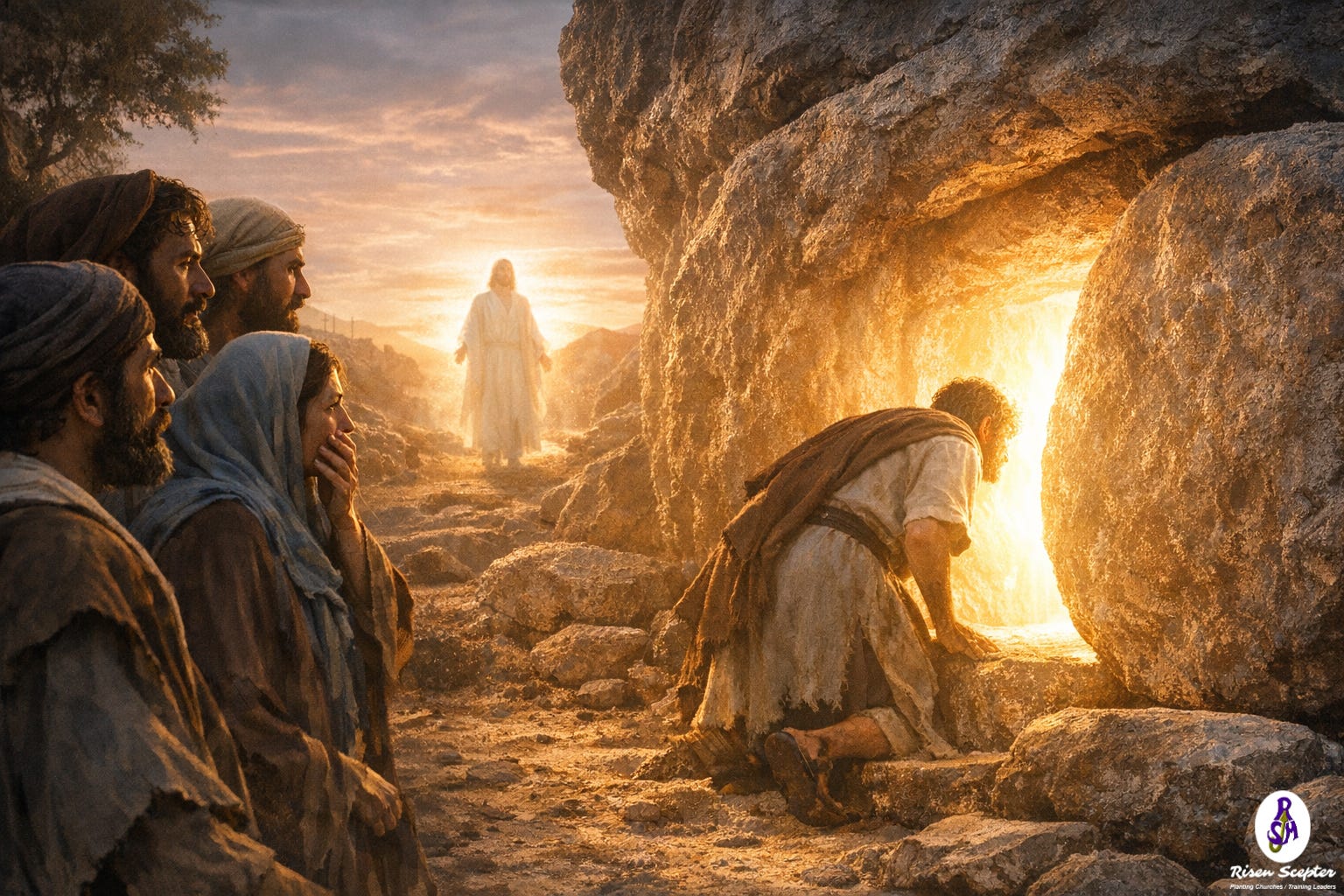
The journey from seeing Jesus through public hearsay to recognizing Him as the King of Glory is one we all must take. Jesus famously forced this move with His disciples, asking, “Who do you say that I am?” (See Matthew 16:15).
The Question of Identity: Jesus’ question in Matthew 16:15, “Who do you say that I am?”, forces a move from public hearsay (”some say Elijah...”) to personal conviction. The Lord challenged His followers to see Him, not as the crowds did, but for who He truly was.
We see this transformation in the lives of those closest to Him:
The Disciples: From “greatly astonished” and fearful to eventually “getting it” after the feeding miracles (Mark 2:12; 4:41; 6:51–52; 8:21-29).
The Apostle Peter: He identified the title “The Messiah” but initially lacked the theology of the Cross. It took the empty tomb to turn a “deserter into a disciple”. (See Mark 8:29; 16:7; John 21:15–19; Acts 2:32–36).
James (Brother of the Lord): He moved from skepticism and disbelief to becoming a pillar of the faith after a specific post-resurrection appearance. (See John 7:5; 1 Corinthians 15:7; Acts 15:13–21; Galatians 1:19).
The Apostle Paul: His “blinding light” transformation took him from a persecutor to a herald of the preexistent Son. (See Acts 9:3–6; Acts 13:33; 1 Corinthians 15:8; Galatians 1:15–16; Philippians 3:7–10).
Our Shared Status: Sons and Daughters of God
The profound truth of the Resurrection is that Christ’s unique Sonship becomes the pattern for a new humanity that transcends all earthly divisions.
He raised us to new life, and in that new life, we take part in creation's renewal by representing Christ to everyone we meet. We have become His image to those around us.
The Last Adam: Jesus is the new head of the “new creation humanity”, replacing the solidarity of Adam’s death with a believing union in Christ’s life. (See 1 Corinthians 15:22, 45; Romans 5).
Sons of the Resurrection: Just as Christ was “appointed the Son of God in power,” we become “sons of the resurrection” through union with Him. (Luke 20:36; Rom 1:4; 8:14–17).
Restoration of Intent: We are being restored to our original intent: true image-bearers of God. This is not a legal fiction; it is a “new creation” reality (see 2 Corinthians 5:17).
In the Body of Christ, ethnic, and social divisions no longer take precedence. (See Galatians 3:28).
The Crescendo: The Scepter and the Renewal of All Things
“God has given us the unique privilege of participating in the renewal of creation.”
Bishop G
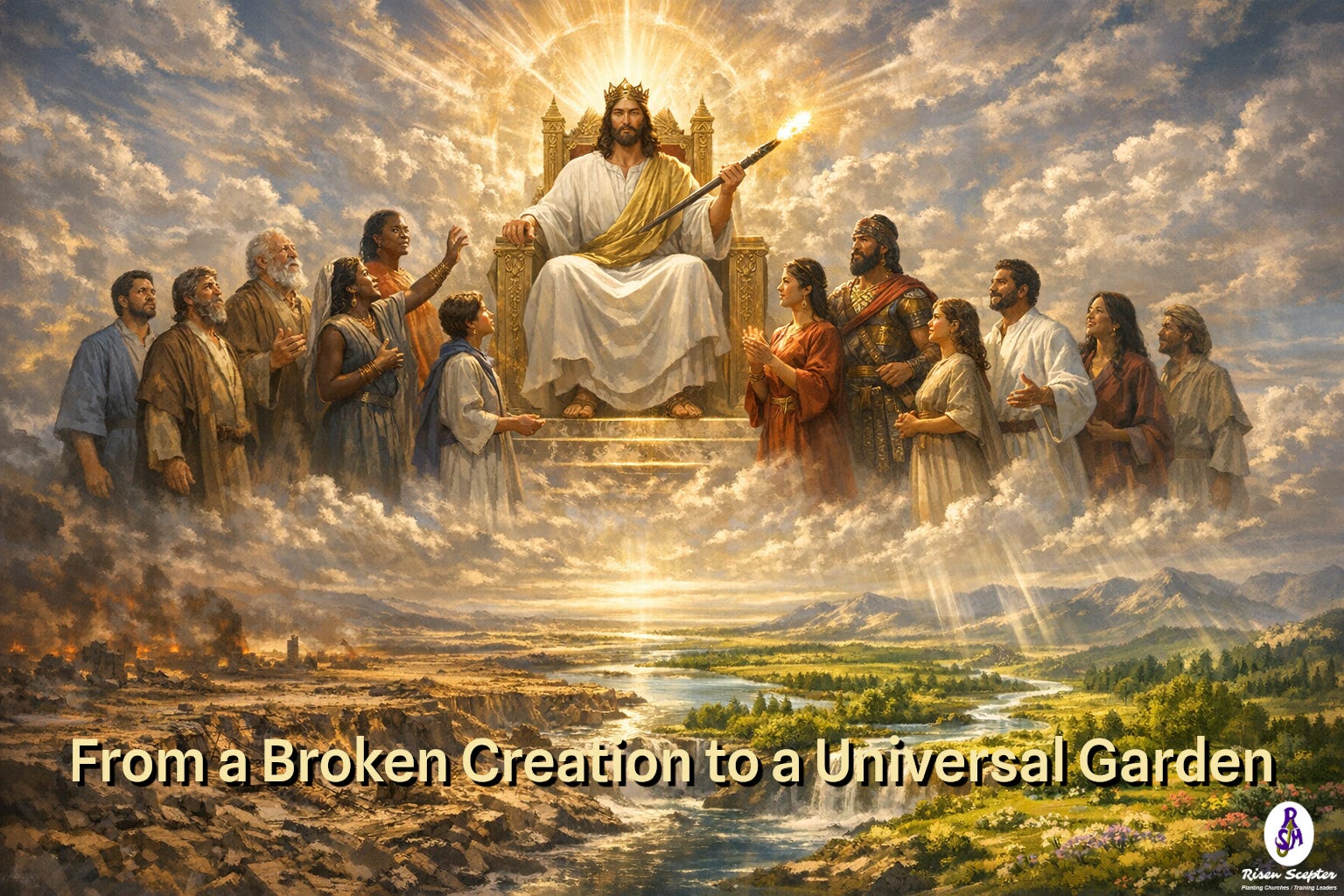
The Groaning of Creation
Scripture tells us that creation is “on its tiptoes,” waiting for the manifestation of the sons of God to be liberated from its bondage to decay. (See Romans 8:19–23).
The “Rod” of Iron
The King’s scepter—that “Rod of Iron”—is used to shatter the “pottery” of wicked systems and chaotic geographical entities. (See Psalm 2:9). Incredibly, the King shares this right to rule with His people.
God gives overcomers authority to participate with Him in breaking the power of darkness. (See Revelation 2:26–27).
The End of the Reign of Darkness
Jesus is reigning until He has put all enemies under His feet. Ultimately, we will physically rise to rule and reign with Christ on the new earth. After abolishing every evil rule and making the Earth brand new, He will hand the perfected Kingdom to the Father, so that “God may be all in all”. (See 1 Corinthians 15:24–28).
Selah
The Lord of Glory has been enthroned—Hallelujah!
Reflection:
The Father declared at the Transfiguration, “This is My Son... Listen to Him!” In what area of your life do you still need to recognize His absolute authority today?
Footnotes (Attributions)
[1] L. Morris, “Resurrection of Jesus Christ,” in The International Standard Bible Encyclopedia, Revised, ed. Geoffrey W. Bromiley (Wm. B. Eerdmans, 1979–1988), 153.
[2] Gordon R. Lewis and Bruce A. Demarest, Integrative Theology: Our Primary Need: Christ’s Atoning Provisions, vol. 2 (Grand Rapids, MI: Zondervan, 1990), 468–471.
[3] Brandon D. Crowe, The Hope of Israel: The Resurrection of Christ in the Acts of the Apostles (Grand Rapids, MI: Baker Academic, 2020), 58–61.
[4] Graeme Goldsworthy, The Son of God and the New Creation, ed. Dane C. Ortlund and Miles V. Van Pelt (Wheaton, IL: Crossway, 2015), 94–105.
[5] Mark J. Keown, Discovering the New Testament: An Introduction to Its Background, Theology, and Themes, vol. I (Bellingham, WA: Lexham Press, 2018), 160–164.
[6] Allison A. Trites and William J. Larkin, Cornerstone Biblical Commentary, Vol 12: The Gospel of Luke and Acts (Carol Stream, IL: Tyndale House Publishers, 2006), 146–147.
Brother this message about the Son and His coronation is so powerful because it takes us straight into the reality of who Jesus truly is not just Savior but King appointed and established by God Himself as it is written You are my Son today I have begotten you Psalm 2:7 and also I have set my King on Zion my holy hill Psalm 2:6 This shows that His authority is not given by man but declared by God What really stands out is that even though the nations resist and the rulers of the earth oppose Him God is not shaken because the one enthroned in heaven laughs and declares His purpose Psalm 2:4 reminding us that no human system or power can overturn what God has established This connects so deeply with what we see in Jesus because after His resurrection He said All authority in heaven and on earth has been given to Me Matthew 28:18 It also reveals that Jesus is not just King over a small people but over all nations because Ask of Me and I will make the nations your inheritance and the ends of the earth your possession Psalm 2:8 and this is why the gospel goes to every nation because He is worthy of all worship as it is written that at the name of Jesus every knee should bow Philippians 2:10 At the same time this kingship is different from earthly kings because His rule is marked by righteousness and truth as it says Your throne O God is forever and ever a scepter of righteousness is the scepter of Your kingdom Hebrews 1:8 and yet this same King humbled Himself and became obedient to the point of death Philippians 2:8 showing that His coronation comes through sacrifice not domination I feel the heart of this message is a call to recognize Him rightly not just as part of our life but as Lord over everything because Serve the Lord with fear and rejoice with trembling and blessed are all those who put their trust in Him Psalm 2:11-12 May we live in that surrender honoring the Son walking in obedience and trusting in His reign knowing that His kingdom cannot be shaken brother